
Gold Ore 101: A Beginner’s Guide to Identification, Types, Extraction, and Value
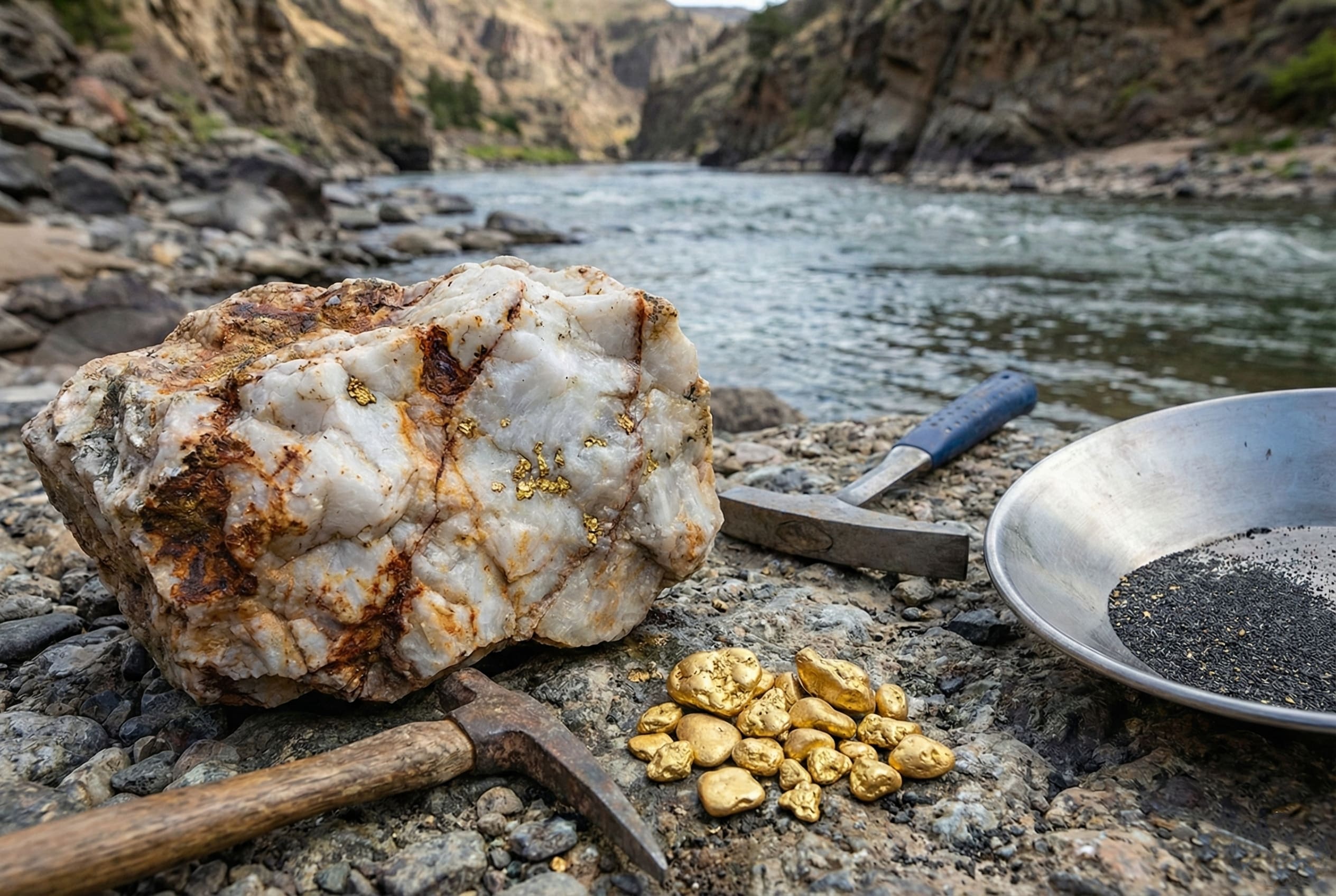
Let’s be honest: when most people think of gold, they picture shiny, smooth nuggets resting at the bottom of a crystal-clear river, just waiting to be picked up.
But in reality? The vast majority of the world’s gold doesn’t look like that. It is hidden inside ugly, ordinary-looking rocks. This is what we call gold ore.
If you’re trying to figure out whether that shiny rock you found is actually valuable, this guide will walk you through the essentials: what gold ore looks like, the major types, and how to test your rock like a real prospector.
What Exactly Is “Gold Ore”?
Before we start digging, let’s define our terms.
The Ore of Gold is essentially a natural rock or sediment that contains a sufficient concentration of gold to make it economically worth mining. The rock surrounding the gold is often called the “matrix” or “gangue.”
Sometimes, the gold is visible to the naked eye (native gold). Other times, the particles are microscopic and trapped inside other minerals, requiring chemical processing to extract.
The 4 Main Types of Gold Ore
Geologists classify gold deposits in many complex ways, but for identification purposes, we can break them down into four distinct categories based on their appearance and formation.
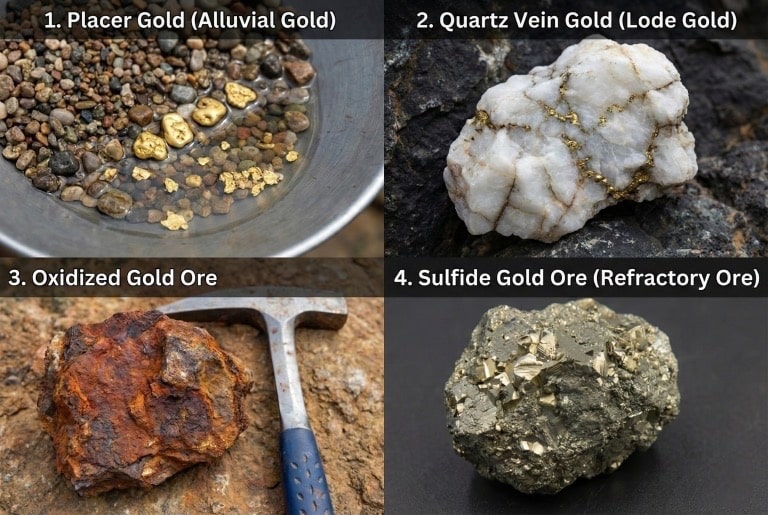
1. Placer Gold (Alluvial Gold)
This is the stuff of movies. Placer gold consists of loose gold particles—dust, flakes, or nuggets—that have eroded from rocks and washed into riverbeds or stream valleys.
-
What it looks like: Because it has been tumbled by water and rocks for centuries, placer gold usually has smooth, rounded edges. It is rarely sharp.
-
Where to find it: Riverbeds, creeks, and ancient dry stream channels. This is the type targeted by panning.
2. Quartz Vein Gold (Lode Gold)
This is the most iconic form of hard-rock gold. Gold often forms from hot fluids flowing through cracks in the earth’s crust, depositing silica (quartz) and gold together.
-
What it looks like: Look for stark white, grey, or rusty quartz rocks with distinct “ribbons” or veins running through them. The gold will appear as metallic yellow specks or streaks embedded directly within the quartz.
-
Pro Tip: Not all quartz contains gold, but almost all hard-rock gold is found with quartz.
3. Oxidized Gold Ore
When gold-bearing rocks are exposed to the surface, air and water weather them down. The sulfide minerals turn into iron oxide (rust), leaving the gold behind.
-
What it looks like: These rocks are usually colorful—rusty red, orange, or brown. The rock might feel crumbly or porous.
-
Why it matters: The “rust” makes the gold easier to extract because nature has already done some of the breaking down for you.
4. Sulfide Gold Ore (Refractory Ore)
This is the tricky one. Here, the gold is locked inside sulfide minerals, such as Pyrite or Arsenopyrite.
-
What it looks like: You might not see the gold at all. Instead, you’ll see a metallic, grey, or brassy-looking rock.
-
The Catch: This is often called “Refractory Ore” because it is stubborn. You can’t just crush it and pan it; it requires roasting or chemicals to release the gold.
How to Identify Gold Ore: The “Real vs. Fake” Tests
This is the most common question: “Is this gold, or is it Pyrite (Fool’s Gold)?”
Pyrite mimics gold beautifully, but it has fatal flaws. Use these three field tests to spot the imposter.
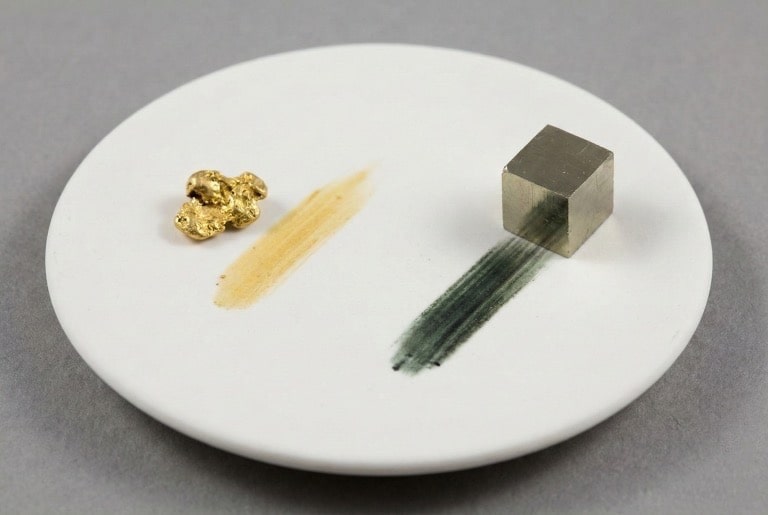
Test 1: The Streak Test (The Best Indicator)
Find a piece of unglazed porcelain (like the back of a bathroom tile). Rub the rock firmly against it.
-
Real Gold: Leaves a yellow/golden streak.
-
Pyrite/Fool’s Gold: Leaves a greenish-black streak.
Test 2: The Hardness & Malleability Test
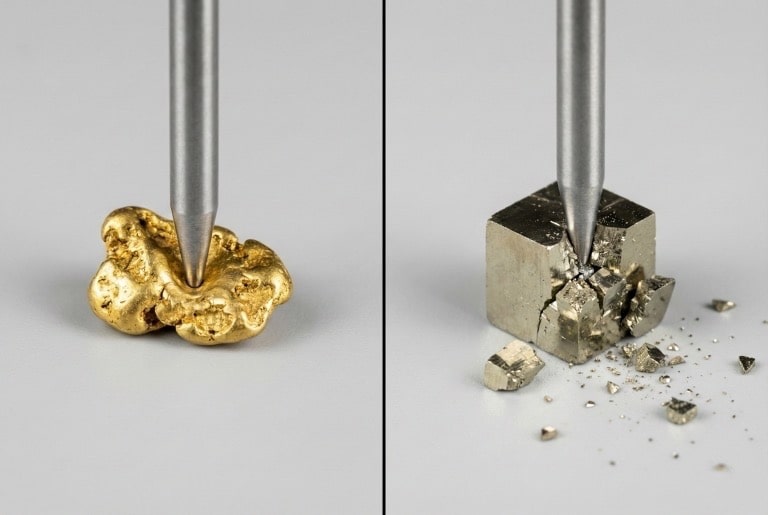
Gold is a soft metal; Pyrite is a hard crystal. Take a sharp pin or a pocket knife and try to poke or scratch the shiny speck.
-
Real Gold: It is malleable. It will dent, flatten, or gouge like a piece of lead. It won’t break.
-
Pyrite: It is brittle. It will shatter into powder or spark. If it crumbles, it’s not gold.
Test 3: The “Heft” Test
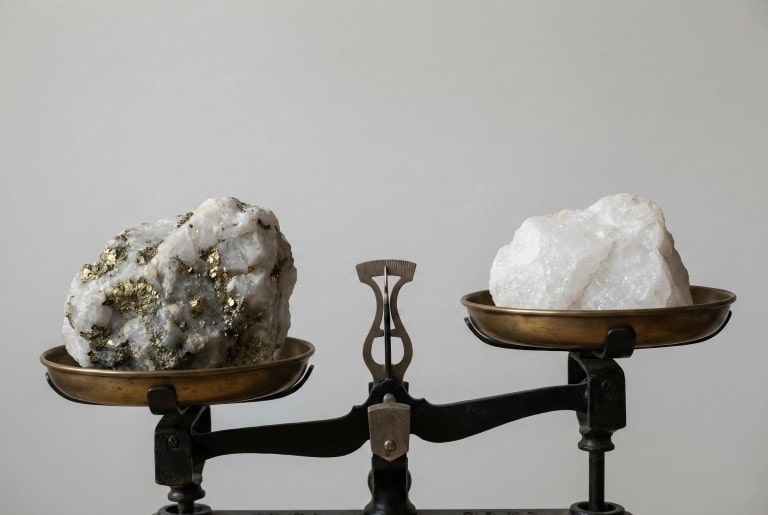
Gold is incredibly dense—roughly 19 times heavier than water.
-
If you have a quartz rock with a significant amount of gold in it, it should feel surprisingly heavy for its size compared to a regular rock. This is often called the “specific gravity” test.
Test 4: The Luster Check
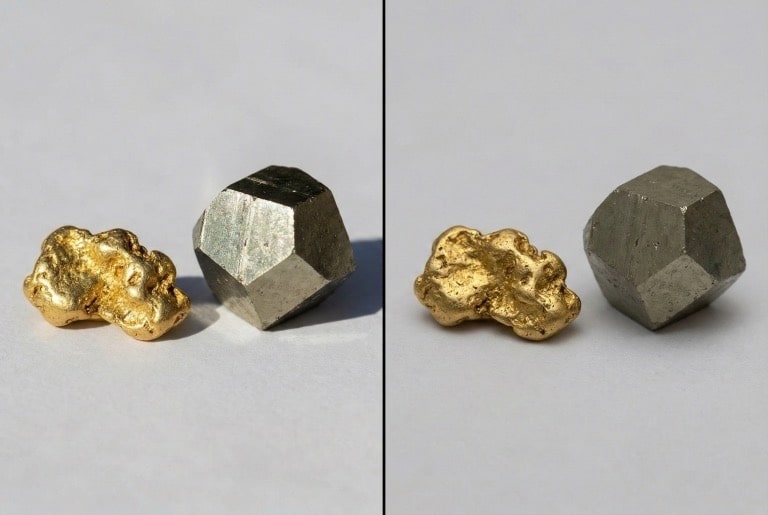
Take the rock into the shade.
-
Real Gold: Maintains its shine and luster even in shadow.
-
Pyrite: Often looks shiny only when sunlight hits it directly; it goes dull in the shade.
Common Associates: What Ores Are Found With Gold?
Gold rarely hangs out alone. It has “friends” (indicator minerals) that often signal its presence. If you see these, keep your eyes peeled:
-
Quartz: As mentioned, this is the number one indicator.
-
Pyrite: Ironically, “Fool’s Gold” is often found near real gold. Don’t discard a spot just because you see Pyrite; the real stuff might be nearby.
-
Black Sands: If you are panning and see heavy black sand (Magnetite or Hematite) at the bottom of your pan, you are in a good geological zone. Gold and black sand settle together because they are both heavy.
-
Chalcopyrite: A copper ore that often looks like gold but has a more yellow-orange hue.
From Rock to Riches: How Is Gold Extracted?
So, you found a rock with gold in it. How do you get the metal out? The process depends on the ore type, but here is the simplified lifecycle:
-
Crushing & Grinding: Big machines (Jaw Crushers and Ball Mills) pulverize the rock into a fine powder. This “liberates” the gold particles from the host rock.
-
Gravity Separation: Since gold is heavy, machines use water and vibration to let the gold settle while washing away the lighter rock dust. This is the industrial version of panning in a river.
-
Chemical Extraction (Cyanidation): For microscopic gold (especially in sulfide ores), the rock powder is treated with a cyanide solution. The chemical dissolves the gold, separating it from the waste rock. It is then precipitated back into solid metal.
What Is It Worth? Understanding the Value of Gold Ore
You’ve found a rock, tested it, and you’re pretty sure it contains gold. The million-dollar question is: How much is it actually worth?
Before you start planning your retirement, it’s important to understand how gold ore is valued. It comes down to two main factors: the Grade and the Specimen Value.
The “Grade” of the Ore (Industrial Value)
In the mining industry, value is determined by concentration. This is called the ore “grade,” usually measured in grams per ton (g/t) or ounces per ton.
-
Low Grade: A rock might contain gold, but if it has less than 1-2 grams of gold per ton of rock, it’s usually not worth the cost of crushing and processing unless you are a massive mining company.
-
High Grade (Bonanza Grade): If an ore contains over 8–10 grams per ton, it is considered high-grade.
The Reality Check: A fist-sized rock with invisible gold inside might only contain $0.50 worth of actual gold metal. The cost to extract it might be $5.00. In this case, the rock is scientifically interesting, but economically worthless as ore.
Specimen Value (The Collector’s Market)
Here is the good news: A rock is often worth more than the gold inside it.
If you find a piece of white quartz with visible veins of gold (Quartz Vein Gold) or a unique nugget structure, do not crush it!
-
Aesthetic Appeal: Collectors pay a premium for “natural gold specimens.”
-
The Premium: A piece of quartz containing $100 worth of raw gold could easily sell for $500 or even $1,000 to a collector simply because it is beautiful and rare.
-
Rule of Thumb: If you can see the gold clearly with your naked eye, it is likely worth far more as a display specimen than if you melted it down.
How to Calculate Price (Roughly)
If you are determined to sell it for the gold content (melt value), the math works like this:
-
Know the Spot Price: Check the current Spot Price of Gold (quoted per troy ounce).
-
Estimate Purity: Placer gold (nuggets) is rarely 24k pure; it’s usually 18k to 22k (75%–90% pure).
-
The Formula: (Weight of Specimen) x (Estimated Gold %) = Actual Gold Weight.
Pro Tip: Never sell raw gold ore to a pawn shop. They will offer you scrap prices. Instead, look for mineral shows, rockhounding forums, or reputable coin dealers who deal in natural nuggets.
FAQs
Q: Is gold ore magnetic?
A: No, gold itself is non-magnetic. However, gold ore is frequently found mixed with iron-rich rocks (like magnetite) which are magnetic.
Q: Can I process gold ore at home?
A: If it is “free milling” gold (like in quartz), you can crush it and pan it. However, if the gold is locked in sulfides, chemical extraction is dangerous and should be left to professionals.
Q: What is the difference between gold ore and gold concentrate?
A: Gold ore is the raw rock mined from the earth. Gold concentrate is the result of processing that ore to remove most of the waste rock, leaving a high-value powder that is ready for smelting.
Conclusion
Finding gold ore isn’t just about luck; it’s about knowing what to look for. While the movies show us glittering nuggets, the reality is often a rusty rock or a streak of yellow in white quartz.
Remember the golden rule: “All that glitters is not gold.” Always perform the streak test and the hardness test before you get too excited. Whether you are exploring an outcrop in the mountains or just reading up on geology, understanding the nature of these ores is the first step to becoming a true prospector.