
The Ultimate Guide to Gold Nugget Prices: What Is Your Find Really Worth?
- The Ultimate Guide to Gold Nugget Prices: What Is Your Find Really Worth?
- The “Nugget Factor”: Why Price Exceeds Spot Value
- How to Calculate Gold Nugget Value (The Formula)
- The 5 Key Factors That Determine Gold Nugget Prices
- Gold Nugget Grading Scale: A Valuation Guide
- Buying and Selling: How to Stay Safe
- FAQs
- Conclusion
If you are holding a natural gold nugget in your hand, you are holding something incredibly rare.
Most people make the mistake of checking the current “Spot Price” of gold and assuming that’s what their nugget is worth. This is a costly mistake.
While the spot price (currently around $4100+ per ounce) dictates the value of refined gold bars, natural gold nuggets operate in a completely different market. They are not just metal; they are gemstones.
In this guide, we will break down exactly how gold nugget prices are calculated, why a 1-ounce nugget is worth exponentially more than gold dust, and how to ensure you don’t get underpaid when buying or selling.
The “Nugget Factor”: Why Price Exceeds Spot Value
First, let’s clarify the difference between Spot Price and Nugget Value.
-
Spot Price: This is the price of 99.9% pure, refined gold (bullion). It is traded on the stock market.
-
Melt Value: If you took your nugget and melted it down, this is the value of the raw gold content (usually 10-20% lower than spot because nuggets aren’t pure 24k).
-
Numismatic (Collector) Value: This is the real market price of a natural nugget.
The Reality: Less than 2% of the world’s gold is found in nugget form. Most gold is microscopic dust that must be refined. Because natural nuggets are so scarce, they command a premium.
Key Takeaway: A high-quality natural gold nugget effectively never sells for just the spot price. It sells for the Spot Price plus a Premium.
How to Calculate Gold Nugget Value (The Formula)
While there is no fixed “sticker price” like at a grocery store, professional dealers use a specific set of criteria to value gold.
The formula generally looks like this:
To understand the “Premium,” you need to analyze the 5 Key Factors.
The 5 Key Factors That Determine Gold Nugget Prices
Not all gold is created equal. A dull, flat nugget from one mine might be worth $80 per gram, while a brilliant, crystalline nugget from another could be worth $150 per gram. Here is why:
1. Weight and Size (Bigger is Exponentially Better)

In the world of nuggets, size matters—a lot.
A 1-ounce nugget is significantly rarer than thirty-one 1-gram nuggets. Therefore, the price per gram increases as the nugget gets heavier.
-
Sub-gram (Pickers): Low premium.
-
1 Gram to 1 Ounce: Moderate premium.
-
Multi-Ounce: Massive premium (Museum quality).
2. Rarity and Origin

Australian gold nugget (L) and Alaskan gold nugget (R)
Where did the gold come from? Famous gold fields often command higher prices due to their history and specific gold characteristics.
-
Australian Gold Nuggets: Known for high purity (often 23k) and rich, buttery yellow color. Highly sought after.
-
Alaskan/Yukon Gold: Iconic history, typically slightly lower purity (18k-21k), often darker or brassier in tone.
-
California Mother Lode: Extremely popular among American collectors.
3. Purity (It’s Not Always 24K)
Natural gold is almost never 100% pure. It is an alloy mixed by nature with silver, copper, and other minerals.
-
Most natural nuggets range from 75% to 95% pure (18K to 23K).
-
While purity matters, beauty often trumps purity in the collector market. A beautiful 18K nugget can be worth more than an ugly 22K nugget.
4. Character and Aesthetics
Does the nugget look like a melted blob, or does it have a unique shape?
-
Crystalline Gold: The rarest form. Sharp, geometric gold crystals are worth significantly more than standard water-worn nuggets.
-
Gold in Quartz: White quartz rock with veins of yellow gold running through it is highly prized for jewelry and display.
5. Physical Condition
Has the nugget been damaged?
-
Natural State: Smooth, water-worn edges are desirable.
-
Mining Damage: If a nugget has a pick-axe scratch or a hammer mark, its value drops towards the “melt value.”
Gold Nugget Grading Scale: A Valuation Guide
To help you estimate pricing, we have categorized nuggets into four main grades.
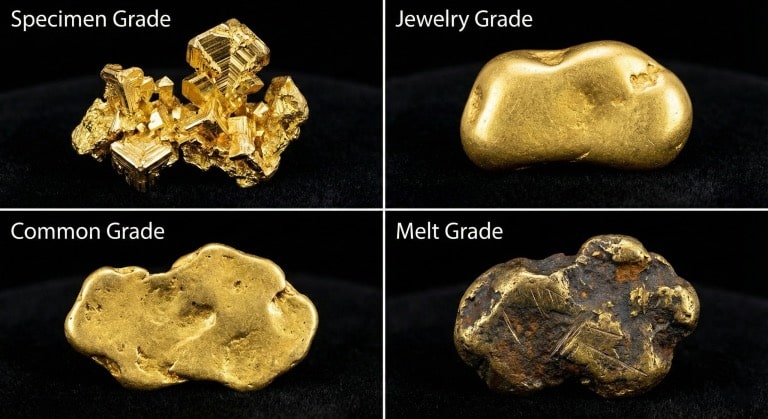
(Note: Premiums are estimates based on current 2025 market trends)
| Grade | Description | Typical Pricing Model |
| Specimen Grade | Rare shapes, crystalline structures, or exceptionally large sizes (1oz+). Museum quality. | Spot Price + 100% to 300% |
| Jewelry Grade | Clean, bright, rounded, and flat. Perfect for pendants. No sharp edges or host rock. | Spot Price + 30% to 50% |
| Common Grade | Standard nuggets. Good color, but ordinary shapes. Typical of small “pickers.” | Spot Price + 10% to 20% |
| Melt Grade | Heavily mineralized, iron-stained, or physically damaged by mining equipment. | Spot Price (or slightly below) |
Buying and Selling: How to Stay Safe
Buying Gold Nuggets
When looking for gold nuggets for sale, always verify the seller.
-
Look for: A “Scale Photo” (the nugget next to a coin or ruler).
-
Ask about: The origin (which creek or state?).
-
Beware: Listings on eBay that sell “Gold Ore” or “Gold Flakes” that turn out to be fool’s gold (pyrite). Stick to certified dealers with return policies.
Selling Your Nuggets
Do not sell your nuggets to a generic “We Buy Gold” store.
These businesses usually only pay for the melt value. They will weigh your nugget, assume it is 18k, and pay you 80% of the melt value. You effectively lose the entire collector premium.
Instead, sell to:
-
Mineral collectors.
-
Specialized nugget dealers.
-
Jewelers who specialize in natural gold jewelry.
FAQs
Q: Are gold nuggets 24k pure gold?
A: Rarely. Most natural gold nuggets range from 18k to 23k. Australian nuggets tend to be the purest (up to 23k), while Alaskan nuggets are often around 20k-21k.
Q: Is it a good investment to buy gold nuggets?
A: Gold nuggets offer two layers of value: the intrinsic value of the gold itself, and the scarcity value of the specimen. As gold production slows down, large nuggets are becoming harder to find, potentially increasing their collector value over time.
Q: How much is a 1-gram nugget worth?
A: As of current market rates, a high-quality 1-gram nugget typically sells for $100 to $120 USD.
Conclusion
Understanding gold nugget prices is about recognizing that you are dealing with nature’s artwork. Unlike gold bars, no two nuggets are the same.
Whether you are a prospector looking to sell your find or an investor looking to own a piece of the earth’s history, remember: Don’t settle for melt value. The rarity, shape, and beauty of a natural gold nugget make it worth so much more.